

Fencing a childcare centre is a different job to fencing a house, even though the materials on the truck often look the same. A family fence needs to keep a backyard tidy and mark a boundary. A childcare centre’s fence is a licensing requirement, a daily safety system relied on by educators who can’t watch every child every second, and, if it’s done badly, a genuine liability for the service operator. It’s worth treating it with the seriousness that comes with all three of those things.
A Class Fencing Solution works with early learning centres and their builders regularly across Melbourne’s west, and the questions are almost always the same: how high, what design, what material, and what actually gets checked. Here’s the plain-English version.
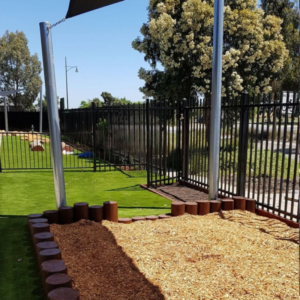
A note before we go further: requirements can differ by service type, council, and the specifics of your site, and they sit across both state building regulations and the national early childhood framework. This article is a starting point for planning, not a substitute for confirming your specific obligations with your regulatory authority, council or architect before fencing goes in.
The Regulatory Basis
Childcare and early learning fencing sits under the Education and Care Services National Regulations, part of the National Quality Framework administered by ACECQA, specifically under Quality Area 3: Physical Environment. The core requirement is written more like a performance standard than a hard number: outdoor spaces must be enclosed by a fence or barrier “of a height and design that children preschool age or under cannot go through, over, or under it.”
That performance-based wording is deliberate. It puts the responsibility on the design to actually work, not just tick a height requirement, but it also means a fence that technically meets a minimum height can still fail an assessment if a determined three-year-old could plausibly get over or through it some other way.
How High Does It Actually Need to Be?
For many years, 1.5 metres was the commonly applied minimum height for childcare fencing in practice, well above the sort of boundary fence you’d put around a typical backyard. Given the regulation is performance-based rather than a fixed number, the right height for your service depends on site-specific factors: what’s on the other side of the fence, ground levels, and what a young child could use to gain extra height near the barrier. This is exactly the kind of detail worth confirming directly with your council or regulatory authority as part of your service approval or renovation planning, rather than assuming a single number applies to every site.
Anti-Climb Design Matters More Than Height Alone
A tall fence that’s easy to climb isn’t actually doing its job, which is why design gets as much attention as height in any competent childcare fencing plan. A few principles come up consistently:
Vertical infill spacing (the gaps between vertical pickets or bars) is generally kept in the range of 80 to 100mm, tight enough that a small child can’t squeeze through and can’t easily get a foothold between uprights.
Horizontal rails and framing are treated with real caution, because anything a child can use as a rung turns your fence into a ladder. Where horizontal members can’t be avoided structurally, they’re typically spaced no less than 900mm apart, and the framing is usually kept on the outside of the fence rather than the inside a child can climb.
An internal anti-climb covering is standard practice on fencing that isn’t already pool-spec, using something like shade cloth or a rigid mesh fixed to the inside face of the fence to remove climbable footholds entirely.
Material Choices We See Most Often
Pool-quality fencing (the same glass or aluminium picket systems used for pool barriers) is often the most effective option for childcare use, since it’s purpose-designed against exactly this kind of climbing risk. It comes at a higher price point but needs the least additional treatment to meet anti-climb requirements out of the box.
Weld mesh and chain mesh are common, cost-effective choices, particularly with an anti-climb internal covering added. They hold up well to weather and heavy daily use, and our in-house powder coating means we can finish them in a colour that matches a centre’s branding or signage rather than leaving bare galvanised steel on a street-facing boundary.
Paling and picket timber fencing still shows up, particularly on older services or sites blending a childcare boundary with a more residential-feeling streetscape. It can meet requirements, but needs careful attention to picket spacing and any horizontal rail placement to avoid creating an accidental climbing frame.
Supervision Sightlines: The Trade-Off Nobody Talks About Enough
Every childcare fencing brief eventually runs into a genuine tension: educators need clear sightlines across the outdoor space to supervise properly, but a fully transparent fence can undermine the anti-climb and containment requirements the barrier exists for in the first place. Solid anti-climb coverings that block hand and foot holds can also partially block a supervising educator’s view of the boundary line itself.
Getting this balance right is a design conversation, not a materials-catalogue decision. It usually means combining a secure lower section with a more open upper section, or choosing a mesh tight enough to prevent climbing but still visually permeable enough for supervision. It’s one of the areas where experience installing for the education and care sector specifically, rather than general residential or commercial fencing, actually shows.
Before You Commit to a Fence Design
If you’re planning a new centre, an outdoor space renovation, or replacing ageing fencing at an existing service, a few things are worth sorting early:
Confirm your specific height and design obligations with your regulatory authority and council before finalising drawings, since this affects permit and development approval timelines.
Loop in your fencing installer during the design phase, not after the outdoor space plan is locked in. Retrofitting compliant anti-climb detailing around an already-finalised layout is more expensive than designing it from the start.
Ask about gate hardware and daily-use durability specifically. A childcare gate gets opened and closed dozens of times a day by staff, parents and delivery drivers, and hardware that’s fine on a quiet residential gate can wear out fast under that kind of use.
A Class Fencing Solution has fenced childcare and early learning services across Melbourne’s west for years, and we know the difference between a fence that looks compliant and one that’s actually been designed around how these spaces get used every day. If you’re planning a new service or upgrading an existing one, get in touch and we’ll work through the design with you, and with your regulatory approvals, before a single post goes in the ground.


Leave A Comment