

Victorians know that summer brings more than long beach days and backyard cricket. It also brings bushfire season. Every year, homeowners on the urban fringe, in regional towns and across the hills prepare their properties for hot, dry, windy days.
Most people think about clearing gutters, trimming trees and packing a fire plan. But one part of the property is often overlooked: the fence. In a bushfire, fences can either help slow the spread of fire and shield your home, or become fuel that carries flames right up to your walls.
At A Class Fencing Solution, we install fencing for homes across Victoria, including many in bushfire-prone areas. In this guide, we explain why your fence matters, which materials perform best and how to make your boundary part of your bushfire preparation this summer.
Why Fencing Matters in a Bushfire
During a bushfire, homes are rarely lost to a wall of flame alone. Many are damaged by ember attack, where burning debris is carried by the wind and lands on or around the property, sometimes well ahead of the fire front. Radiant heat and direct flame contact also play a role.
A combustible fence can catch embers, ignite and burn for a long time, creating a line of fire that leads straight to your house, shed or garage. A non-combustible fence, on the other hand, will not add fuel and can act as a barrier that helps block radiant heat and deflect embers.
In short, the right fence can be a genuine part of your bushfire defence, not a liability.
Understanding BAL Ratings
In Australia, the risk to a building in a bushfire-prone area is assessed using a Bushfire Attack Level, or BAL, under Australian Standard AS 3959. Ratings range from BAL-LOW through to BAL-FZ (Flame Zone), based on factors like vegetation type, distance to vegetation and slope.
Your BAL rating shapes the construction requirements for your home, and in some situations it can also influence what is appropriate for fences and gates close to the building. In Victoria, properties may also sit within a Bushfire Management Overlay, which can bring extra planning requirements.
Before you build or replace a fence, check your property’s BAL and any overlays with your local council or a building surveyor. It is the best way to make sure your fence is safe and compliant.
The Best Bushfire-Ready Fencing Materials
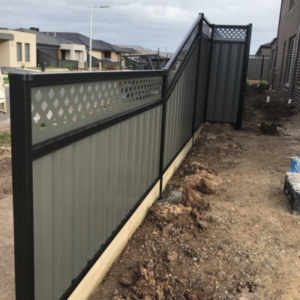
1. Colorbond Steel Fencing – The Top All-Rounder
Colorbond steel fencing is one of the most popular bushfire-ready choices in Victoria, and for good reason. Steel is non-combustible, so it will not ignite or add fuel to a fire.
- Non-combustible panels, posts and rails when installed as a complete steel system.
- Solid panels help shield against radiant heat and wind-blown embers.
- Does not rot, warp or attract termites, so it stays strong year after year.
- Low maintenance, which means no flammable build-up of flaking paint or weathered timber.
- Available in a wide range of colours to suit rural and suburban homes.
For many properties, a Colorbond steel fence offers the best balance of safety, durability, privacy and cost.
2. Masonry and Brick Fencing – Maximum Protection
Brick, block and rendered masonry fences are extremely fire resistant and provide a strong barrier against radiant heat. They are durable, low maintenance and add a solid, permanent feel to a property.
- Excellent fire and heat resistance.
- Very long lifespan with minimal upkeep.
- Great for front boundaries and feature walls.
The trade-off is cost and construction time. Masonry is usually more expensive and may need engineering for taller walls.
3. Aluminium and Steel Slat Fencing – Modern and Non-Combustible
Metal slat fencing brings a contemporary look while remaining non-combustible. It is a popular choice for front fences, pool surrounds and feature screens in bushfire-prone areas.
- Aluminium and steel will not burn.
- Low maintenance and rust resistant options are available.
- Keep in mind that gaps allow some embers and heat through, so solid fencing may be better closest to the house.
4. Gabion and Stone Walls – Natural and Fire-Safe
Gabion walls, made from wire cages filled with rock, and natural stone walls offer a rugged, rural look with excellent fire resistance. They suit larger blocks, acreage and landscaped properties.
Materials to Be Cautious With
Timber Fencing
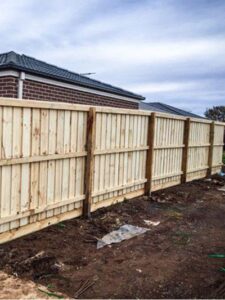
Timber paling and lapped fences are common and attractive, but timber is combustible. In a bushfire, a timber fence can ignite from embers and carry fire towards your home. If you have or prefer timber, keep it well maintained, clear debris and dry vegetation from its base, and avoid running it right up against the house. Where a fence connects to your home, consider a non-combustible section or gate at that junction.
Brush and Brushwood Fencing
Brush fencing looks natural but is highly flammable and is generally not recommended close to homes in high-risk areas.
Plastic and Vinyl Fencing
Some plastic products can melt, deform or burn under intense heat, so check fire performance carefully before choosing them in a bushfire-prone location.
Smart Fencing Tips for Bushfire Season
Choosing the right material is the first step. How you maintain and plan around your fence matters just as much:
- Clear the fence line: remove leaf litter, dry grass, woodpiles and garden waste from along the fence.
- Watch where it meets the house: a non-combustible section where the fence joins the building helps stop fire tracking along the fence.
- Keep gates practical: make sure gates open easily and provide clear access for firefighters and emergency vehicles.
- Plan your landscaping: avoid highly flammable plants and mulch hard against the fence.
- Check for damage: repair gaps, loose panels and fallen sections before summer arrives.
- Keep a hose within reach: make sure water can reach the full length of your fence line.
Consider Automated Gates
For rural and semi-rural properties, a reliable gate is an important part of your evacuation plan. Automated steel gates offer quick, easy access for your family and emergency services. Just make sure the system has a manual release so the gate can still be opened if the power fails during a fire.
Our Recommendation for Victorian Homes
For most homes in bushfire-prone parts of Victoria, we recommend:
- Colorbond steel fencing for boundaries, combining fire safety with privacy and value.
- Masonry or stone for front fences and feature walls where budget allows.
- Metal slat fencing for modern designs, used thoughtfully away from the most exposed areas.
- A non-combustible section where any fence connects to the home.
Always confirm your specific requirements with your council or building surveyor, and follow the latest guidance from the CFA when preparing your property.
Build a Safer Boundary with A Class Fencing Solution
At A Class Fencing Solution, we help Victorian homeowners choose and install fencing that looks great and stands up to our tough summers. From Colorbond steel fencing and slat fencing to gates and automation, our team can recommend the right solution for your property and your risk level.
Do not wait until the first hot northerly to think about your fence. Visit aclassfencingsolution.com.au to request a free quote and get your property bushfire-ready before summer.


Leave A Comment