

Drive around Melbourne’s west and you’ll see it. Two aluminium slat fences, same street, same age, same colour on the day they went up. One still looks close to new. The other has gone chalky on the north facing side, with a fine bloom of white creeping out from under the coating near the posts.
Same design, same material, very different coating job.
Powder coating is the part of a fence nobody asks about at quoting time and everybody notices at year six. A Class Fencing Solution runs its own powder coating line at Ravenhall, so here’s what actually separates a coating that lasts from one that doesn’t.
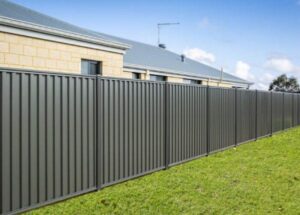
What powder coating is, briefly
It isn’t paint. Dry pigment and resin powder is given an electrostatic charge and sprayed at an earthed metal part. The charge makes it cling evenly, including around edges and into corners where wet paint would run or thin out. The part then goes into an oven, the powder melts, flows together and chemically cross links into a single continuous skin, typically 60 to 100 microns of film bonded to the metal rather than sitting on top of it.
That’s the theory. Whether you actually get it depends on the three things below.
1. Pre treatment: the step that decides everything
Ask any coater what causes failures and they’ll say the same thing. Powder doesn’t fail because the powder is bad. It fails because of what was underneath it.
Metal arrives with oil from manufacturing, dust from transport, fingerprints from handling, and on galvanised steel a layer of zinc oxide that forms just from sitting in the weather. Coat over any of that and you’ve bonded the powder to contamination, not to metal.
Proper pre-treatment means degreasing, rinsing, applying a conversion coating that gives the powder something to key into, rinsing again, and drying thoroughly. Miss a rinse and residual chemistry sits under the film, quietly working away at the bond.
Galvanised steel needs extra care again. Zinc holds gas that escapes during curing, and if it isn’t managed you get pinholes, small enough to miss on handover but big enough to let moisture reach the substrate. When a coating lifts or blisters around fixings a few years in, pre treatment is almost always the cause.
2. The powder grade, and where it’s allowed to be used
Not all powders are engineered for outdoor Australian conditions. Standard polyester powders are fine indoors and for short outdoor service. Architectural grades are a different product, formulated with UV stable resins and pigments to resist chalking and fade.
Supplier warranty tiers make the gap concrete. Entry level architectural products typically carry around 10 years on film integrity and colour, with restrictions attached. They’re often limited to low rise residential and required to be more than 100 metres from salt water. A super durable grade runs to 25 years film integrity and 15 years colour retention, while premium fluoropolymer products reach 30 and 20 with no coastal distance limit.
Two things follow. If your property is near the bay, powder grade isn’t a nice to have, because the cheap product simply isn’t rated for it. And those warranties only exist through approved applicators. A coater outside the supplier’s approval program can use the same powder and you get no warranty at all, because there’s no verified process control behind it.
3. The cure: metal temperature, not oven temperature
This one is invisible on the day and decisive later.
Powder cross links according to how hot the metal itself gets and how long it stays there, commonly around 180 to 200°C for ten minutes at metal temperature. A thick steel gate frame takes considerably longer to reach that than a thin aluminium slat, even in the same oven.
Under cure and the chemistry never completes. The fence looks perfect at handover, then chalks early, loses gloss unevenly and marks when you clean it, because the film never developed the hardness it was meant to have. Over cure brings its own problems, mainly yellowing and embrittlement in lighter colours.
Getting it right means monitoring parts, not just oven dials.
Why we brought it in house
The industry norm is to send fabricated work out to a third party coater, wait, and hope. Bringing the process inside A Class Fencing Solution’s Ravenhall facility changed a few practical things.
We control the pre-treatment. Nothing is coated because a schedule says so. If a batch of galvanised needs extra attention before it goes near powder, it gets it.
Batches stay together. Colour can vary slightly between powder production batches. It’s subtle, but visible when a gate sits next to the fence it’s supposed to match. Coating a job as one run keeps panels, posts, slats and gates consistent.
Lead times shrink. No freight in each direction, no waiting in someone else’s queue. On a job with a site deadline, that’s often the difference between finishing this week and next month.
Repairs and specials are actually possible. Custom lengths, an odd bracket, a panel damaged in transit, a section replaced after a storm. We can coat it to match rather than telling you it can’t be done.
One point of accountability. If something isn’t right, it’s ours. There’s no conversation about whether it was the fabricator or the coater.
What to ask any fencer quoting you
Four questions, and they’re fair to ask anyone.
- What powder grade and product are you using, and what’s its warranty?
- Is the coater an approved applicator for that product?
- How is the metal pre-treated, particularly if it’s galvanised?
- Will my gates and fence panels be coated in the same batch?
A coating that lasts 25 years and one that lasts eight look identical on handover day. The difference sits entirely in the answers to those questions.
Looking after it
Powder coating is low maintenance, not no maintenance, and most warranties require basic care. Wash it down with mild detergent and water every six months, more often within a few kilometres of the bay and in sheltered spots where rain doesn’t naturally rinse the surface. Skip solvents, abrasive pads and close range pressure washing, and touch up deep scratches that reach bare metal. That’s the whole schedule.
Want to see it?
The A Class Fencing Solution powder coating line runs at our Ravenhall facility, and we’re happy to talk through colours and grades for your job across Melbourne and regional Victoria. If you’re weighing up colours as well as coatings, our guide to choosing a fence colour that suits your house is worth a read next.


Leave A Comment