

Ask a hundred Melbourne homeowners what colour their new fence should be and about sixty will say Monument. Not because they’ve thought about it, but because it’s what the display home had, what the neighbour picked, and what gets suggested first.
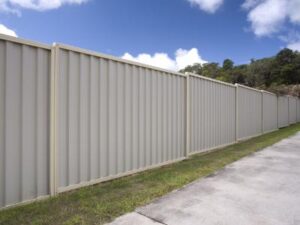
The monument is a good colour. It’s just not automatically your colour. A fence is one of the largest single colour surfaces on your property and it’s there for twenty years, so it’s worth ten minutes of actual thought.
Here’s how A Class Fencing Solution walks clients through it.
Start with the roof, not the walls
The instinct is to match the fence to the house walls. It usually doesn’t work, because walls are broken up by windows, eaves and landscaping, while a fence reads as one uninterrupted band.
Look instead at your roof, gutters and window frames. Those already carry a strong solid colour, and a fence that relates to them looks deliberate rather than accidental. It’s exactly why so many charcoal roofed homes end up with charcoal fences and look fine.
If your roof is terracotta or a warm tile, the charcoal default is usually the wrong call. Warm neutrals sit far more comfortably.
Think about which way the fence faces
Colour behaves differently depending on where it sits.
Dark colours absorb more heat. On a north or west facing boundary catching full afternoon sun, a dark fence gets genuinely hot to touch, and steel expands and contracts more across the day. Modern Colorbond steel uses solar reflectance technology that helps considerably, but physics is physics. A Surfmist fence and a Monument fence in the same sun are not the same temperature.
That matters most where people make contact with it: around pools, along a narrow side path, or where kids play. Light colours have the opposite issue and can throw glare into west facing windows. Mid tones are the safe middle ground.
Be honest about dirt
This is the practical consideration nobody raises at the quote and everybody raises at the twelve month mark.
Very light colours (Surfmist, Classic Cream, Merino) look crisp and make a small yard feel bigger. They also show mud splash, lawn clippings, sprinkler mineral marks and general road grime, particularly along the bottom 300mm.
Very dark colours (Monument, Ironstone, Basalt) hide splash beautifully and show dust, pollen and dried rain marks. In a new estate with unsealed roads or active construction nearby, a black fence can look dusty within a week.
Mid greys and warm neutrals (Woodland Grey, Dune, Windspray, Wallaby) are the low maintenance middle. They’re the colours we recommend most often to people who don’t want to think about their fence again.
None of these is a deal breaker, since all of them wash off. But knowing which way your choice leans stops the surprise.
Colour families and what they suit
Charcoals and near blacks. Monument, Ironstone, Basalt. Suits contemporary rendered homes, black window frames and minimal landscaping. Strong and architectural, though it can feel heavy on a small yard or against a lot of red brick.
Mid to warm greys. Woodland Grey, Windspray, Wallaby, Shale Grey. The most forgiving family. Works with almost any roof, recedes visually so the garden reads as the feature, and hides dirt well.
Warm neutrals. Dune, Paperbark, Merino, Classic Cream. Suits brick homes, terracotta roofs, established gardens and weatherboards. Softens a boundary rather than defining it.
Greens. Cottage Green, Pale Eucalypt. Underrated. Against mature planting a green fence essentially disappears, which is the point.
Reds and heritage tones. Manor Red and similar. Period homes and red brick streetscapes where a charcoal fence would look imported from another suburb.
The Colorbond fencing palette is deliberately smaller than the roofing range, so it’s worth checking current availability before you fall in love with something.
Where powder coating opens things up
Colorbond steel comes in its factory colours. Anything A Class Fencing Solution powder coats in house, including aluminium slats, blade fencing, gates, frames, pool fence panels and balustrade, can be finished in a much wider range, including matching a specific colour on your home.
Clients use this two ways. Matching means a gate finished to sit seamlessly with an adjacent Colorbond fence, or slats matched to existing window frames. Deliberate contrast means a fence in a quiet mid grey with gates and a feature screen in a darker accent tone, drawing the eye to the entry.
Two toning is worth knowing about too. Many Colorbond fence systems let you run a different colour on the frame and rails to the infill sheets, and a darker frame with lighter infill gives a fence definition that a single flat colour doesn’t.
The bit people forget: it’s a shared decision
If it’s a boundary fence between two properties, colour isn’t only your call. Under Victorian fencing law, a fence you’re asking your neighbour to contribute to should be agreed on, and colour is part of that agreement.
Sort it early and put it in writing with the rest of the details. A neighbour who was never consulted about a black fence they now look at every day is a problem no coating can fix.
If you’re in a newer estate, also check your design guidelines or covenant before ordering. Some estates specify permitted fence colours, particularly for anything visible from the street. It’s a quick check that saves an expensive one.
Look at samples properly
Three rules, and they take you no time at all.
Look at the sample at the actual fence line, not on the kitchen bench. Reflected light from lawn, brick and paving changes a colour more than people expect.
Hold it vertically. A sample lying flat catches sky and reads far lighter than it will standing up.
Check it twice, once in morning light and once late afternoon. Greys in particular swing warm and cool through the day.
If you want a safe answer
For resale, mid to dark greys are the least likely to date and the least likely to put off a buyer. For living with it, pick the one that makes your garden look better, because that’s the view you actually have.
A Class Fencing Solution brings physical samples to every quote across Melbourne and Victoria, and we can show you powder coat options straight from our Ravenhall facility. If you’d like to understand what’s happening under the colour, our guide to in house powder coating covers how the finish is applied and why it determines how long it holds up.


Leave A Comment