

It’s the question we’re asked before almost any other, usually within the first minute of a phone call. Fair enough too people want to know how long the dog stays inside, how long the pool sits unusable, or how long the back of the property is open to the street.
The honest answer is that most standard residential fences are installed in a day or two. But that’s the installation. The full timeline from the first phone call to the last paling going on is a longer story, and it’s the part that catches people out.
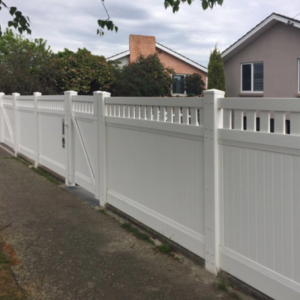
Here’s how it actually breaks down.
The part everyone underestimates: before we start
Installation is the short end of the process. What comes before it is where the weeks live.
Getting a quote. Once you get in touch, we need to understand the site the length of the run, the fall of the ground, access, what’s coming out and what’s going in. Some of that can be sorted over the phone; most jobs benefit from someone looking at it properly.
Sorting out the neighbours. If it’s a boundary fence shared with a neighbour, that conversation needs to happen and it’s not one we can have for you. In our experience this is the single most common reason a job sits waiting. Start it early, well before you’re ready to build.
Materials. We supply our own materials directly rather than waiting on a third party, which takes a lot of the usual delay out of the equation. Custom work is the exception if you’re after a specific powder-coated colour for slat or blade fencing, that’s produced through our in-house powder coating facility and needs its own run time. Worth planning for rather than discovering late.
Scheduling. Victoria’s weather has opinions about fencing. So does the calendar spring and the run-up to Christmas are our busiest stretches by a distance. A job booked in February will start sooner than the identical job booked in October.
Installation time by fence type
Assuming a straightforward suburban site with reasonable access, here’s the shape of it.
Standard timber paling — around 1 to 2 days. The most common fence we build. A typical suburban boundary run of 20 to 30 metres is comfortably a one to two day job for a crew.
Paling with capping — allow a little longer. More components, more handling, more finishing work. The capped versions with expanded 125×75 or 125×125 posts sit at the heavier end and take a bit more time to set out and stand up.
Colorbond — often quicker than people expect. The system is designed to go together efficiently. A standard residential run frequently comes in inside a day. Adding a sleeper at the base is extra work but not dramatically so.
Slat and blade fencing — 2 to 3 days and up. These are precision jobs. Spacing has to be consistent because any variation is immediately visible, and the finish matters in a way it doesn’t on a paling fence.
Acoustic fencing — 2 to 3 days. Heavier panels, more substantial posts and footings, and a job where the details genuinely affect performance. Rushed acoustic fencing doesn’t do what it’s supposed to do.
Brush fencing — 2 days and up. A different craft with a different rhythm. Not a fence to hurry.
Pool fencing — usually a day, but compliance leads it. The installation itself is rarely the long part.
Gates — half a day to a day on top. A basic gate is quick. Sliding gates, cantilever gates and automatic gates involve more setting out and, in the case of automation, more commissioning. Driveway gates in particular deserve their own line in the schedule rather than being treated as an afterthought on a fence job.
Commercial, industrial, factory and childcare fencing — a week or more. Larger runs, more compliance, staging around a working site. These are quoted individually because no two are alike.
Retaining walls — variable, and often the long pole. Engineered retaining walls involve design and approval steps that sit outside the build. If your fence sits on top of a retaining wall, the wall sets the timeline for the whole job.
What stretches a job out
Several things reliably add time, and it’s better to know about them upfront than discover them on day two.
Removing the old fence. Demolition and disposal is a real chunk of work, particularly if the old posts were well concreted in. Add most of a day for a typical residential removal.
Sloping blocks. Melbourne has plenty of them. A fence on a fall has to be stepped or raked, and either way it’s more setting out, more measuring and more time per metre.
Difficult access. If everything has to come through a side gate by hand rather than off the truck, that changes the numbers.
What’s in the ground. Rock, old concrete, tree roots and services all slow the digging. Nobody knows what’s down there until the auger goes in.
Concrete curing. Footings need time before they carry load. On some builds we’ll set posts and return to complete the fence, which spreads the job across a longer window even though the total labour hasn’t changed. This isn’t a delay it’s how you get a fence that stays where you put it.
Weather. Wet ground is difficult and unsafe to work in. A run of Melbourne winter rain moves schedules, and there’s no way around that.
A realistic overall picture
For a standard residential paling or Colorbond fence, most customers should think in terms of a few weeks from first contact to finished fence, with the actual on-site work being one to two days of that. The gap is quoting, neighbour agreement, scheduling and materials — not us standing around.
For anything custom, engineered, automated or commercial, plan on longer and start the conversation earlier.
Get a real answer for your job
Every one of these numbers moves with the site. The only way to get a timeline you can plan around is to have someone look at what you’re actually dealing with.
We install across Australia and right through Victoria, and we’re one of the larger fencing installers in the state which means crews, capacity and realistic start dates rather than a long wait for a one-man operation.
Call us on 0406 200 002 or 03 8375 1800, or email info@aclassfencingsolution.com.au. Installations run Monday to Friday, and our office is open Monday to Friday 7am to 4pm and Saturday 7am to 1pm.


Leave A Comment