

Every commercial or industrial site has a different idea of what “secure” actually means. A childcare centre’s fencing brief is about keeping small children safely contained. A construction site is about keeping the public out and liability down. A distribution warehouse full of stock is thinking about after-hours break-ins and forced entry. They’re all “security fencing,” but the right product for each job looks nothing alike, and getting that match wrong is either an expensive over-spend or a genuine vulnerability.
After close to two decades fencing properties across Melbourne, the team at A Class Fencing Solution has found most commercial and industrial jobs land on one of three core fencing types. Here’s how they stack up against each other, and how to figure out which one your site actually needs.
Chainwire (Cyclone) Fencing: The Reliable Default
Chainwire is the fencing equivalent of a workhorse ute: not glamorous, but it turns up to every job and gets it done. It’s the most cost-effective option on this list, quick to install over long runs, and durable enough to handle years of weather and knocks without complaint. For general perimeter security around a construction site, storage yard, or industrial lot where the goal is a clear boundary and a basic deterrent, it’s usually the right call.
On its own, chainwire offers moderate security. It’ll stop casual wandering and mark a clear legal boundary, but it’s climbable and cuttable without much specialist effort. Where it earns a genuine security upgrade is with add-ons: barbed wire or razor wire toppers along the top rail push the deterrent factor up considerably, which is common on sites where after-hours intrusion is the main concern rather than daytime foot traffic. It’s worth checking what your site’s insurer or head contractor expects here, since some construction and logistics contracts specify a minimum topper spec.
Palisade Fencing: Maximum Deterrence
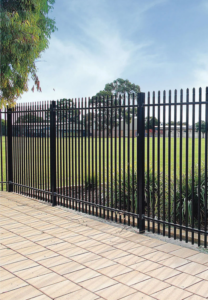
Pressed spear palisade fencing is the step up when a determined intruder is the actual threat model, not just an opportunistic one. Built from heavy-duty steel pickets with pointed tops set close together, it’s genuinely difficult to climb and hard work to cut through, which makes it a common choice around substations, utilities infrastructure, government sites, and any facility storing high-value or hazardous materials.
It comes at a premium compared to chainwire, both in material cost and installation time, since each picket needs to be individually set and secured. But for sites where a breach carries real consequences (safety, liability, or straight-up asset loss), that premium is usually the cheapest insurance policy on the property. Palisade also reads visually as serious security from the street, which has its own deterrent value before anyone even tests the fence line.
Weldmesh Fencing: Security That Doesn’t Look Like a Prison Yard
Weldmesh sits in the middle ground, and it’s increasingly the pick for commercial sites that need genuine anti-climb security but also care about how the property presents to staff, customers or the street. Made from thick steel wire welded at every intersection rather than woven, it’s considerably harder to climb or distort than chainwire while keeping a cleaner, more architectural look than palisade.
We see weldmesh specified a lot for commercial premises, schools, council facilities, and warehouses in mixed-use areas where the fence is part of the streetscape as much as it’s a security measure. It’s mid-range on cost, sitting between chainwire and palisade, and it powder coats well, which matters more than people expect once a fence has been sitting in the Melbourne weather for a few years.
Why Powder Coating Matters More Than People Think
This is where our in-house powder coating facility earns its keep on commercial jobs. Bare or basic galvanised steel fencing will hold up structurally, but it weathers unevenly, shows rust streaking at welds and cut edges over time, and does nothing for a business trying to present a consistent brand image at its front boundary. Powder coating a weldmesh or palisade fence in a specific colour (often matched to a corporate palette or signage) gives you a fence that still looks intentional five years in, not just functional.
Running powder coating in-house also means we’re not waiting on an external contractor’s schedule to turn a fencing job around, which matters when a commercial client is working to a site handover date or an insurance-driven deadline.
Temporary vs. Permanent: Get the Right Product for the Job’s Timeline
Not every site needs a permanent fence, and it’s worth being clear-eyed about that before you spec one. Temporary fencing, the modular panel systems you see around construction sites, typically hires for somewhere around $1.00 to $2.50 per metre per week, or you can buy panels outright from roughly $60 to $100 each if you’re running a longer project or multiple sites. For a construction program running months rather than years, hiring is almost always the more sensible spend, freeing up capital for the actual build.
Permanent fencing makes sense once a site’s boundary, use and security needs are settled: a completed warehouse, a fitted-out childcare centre, an operating facility. Mixing the two up, either hiring long-term when buying would have paid for itself, or installing permanent fencing on a site that’s about to change use, is one of the more common budget mistakes we see on commercial jobs.
A Few Other Things Worth Factoring In
- Access and gates matter as much as the fence line. A high-security fence undermined by a gate that doesn’t self-latch, or automation that isn’t integrated with your access control system, is a weak point attackers know to look for first.
- Sightlines and CCTV coverage should be planned alongside the fence, not after it goes in. A fence that creates blind corners can work against your overall security rather than for it.
- Council and planning requirements vary by site use and zoning, particularly for fence height and topper restrictions in commercial and mixed-use areas, so it’s worth checking before you lock in a spec.
Every one of these fence types has a place. The trick is matching the product to what’s actually threatening your site, not just picking the most secure option by default and blowing the budget. If you’d like a second opinion on what your commercial or industrial property actually needs, the team at A Class Fencing Solution can walk your site, talk through the trade-offs, and put together a fencing solution that fits both the security brief and the budget.


Leave A Comment