

Choosing the right driveway gates can make a significant difference to the security, access and appearance of your property. Two of the most popular options are sliding gates and swing gates. Both can provide controlled access and improve the entrance to a residential, commercial or industrial property, but they operate differently and suit different site conditions.
The best option depends on factors such as available space, driveway layout, security requirements, automation preferences and the overall design of your property. Understanding the differences between sliding and swing driveway gates can help you make a more informed decision.
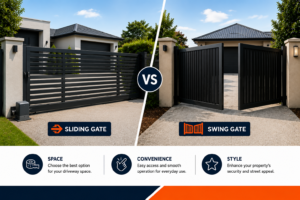
What Are Sliding Driveway Gates?
Sliding gates open horizontally along a track or are designed as cantilever gates that move sideways across the entrance. Instead of swinging into or out of the driveway, the gate moves parallel to the fence line.
This makes sliding gates a practical option for properties where there is limited space in front of or behind the entrance. They can also be suitable for wider driveways and locations where a swinging gate could interfere with vehicles, landscaping or other structures.
Sliding gates are available in different designs and materials, depending on the requirements of the property. They can be used for residential driveways as well as commercial and industrial access points.
What Are Swing Driveway Gates?
Swing gates open by moving inward or outward from hinges attached to supporting posts or columns. Depending on the design, they may be single-leaf or double-leaf gates.
Swing gates can provide a traditional and attractive entrance. They are often chosen for properties where there is enough space for the gate leaves to open safely without obstructing vehicles, pathways or other areas.
The design of swing gates can vary considerably. They may be selected to complement the existing fencing, architectural style or overall appearance of a property.
Space Requirements: Sliding vs Swing Gates
Available space is one of the most important factors when comparing these two gate types.
Sliding gates require sufficient space alongside the driveway for the gate to move into the open position. This means the fence line beside the driveway must generally provide enough clear space for the gate leaf to slide across.
Swing gates require clear space within the opening area. The gate must have enough room to swing without hitting vehicles, walls, landscaping or other obstacles.
For a property with limited space in front of the driveway but sufficient room along the fence line, sliding gates may be a practical option. If there is adequate clearance within the driveway entrance and no obstruction to the swing path, swing gates may work well.
Security Considerations
Both sliding and swing driveway gates can provide an additional level of access control for a property.
Sliding gates can be particularly suitable for larger entrances and areas requiring controlled vehicle access. Their design can also work well with automated systems, depending on the gate configuration and installation requirements.
Swing gates can also provide secure access when correctly designed and installed. The level of security depends on the complete gate system, including the gate design, locking mechanism, supporting posts and access control equipment.
For commercial and industrial properties, the gate should be selected according to the level of traffic and security required.
Which Gate Is Better for Automation?
Both sliding and swing gates can be automated, but the suitable system depends on the gate design and site conditions.
Automatic sliding gates can be convenient for properties with regular vehicle access. The gate can move sideways to allow entry and exit without requiring the driver to leave the vehicle.
Automatic swing gates can also provide convenient access. However, the automation system must be suitable for the size, weight and movement of the gate.
Before choosing an automatic system, it is important to consider the gate dimensions, expected usage, available power and the space required for safe operation.
Driveway Layout and Property Design
The design of the driveway should also influence your decision.
A straight driveway with sufficient space beside the entrance may be well suited to sliding gates. A property with a more traditional entrance and enough clearance for the gate to open may be suitable for swing gates.
The appearance of the gate is also important. A driveway gate is often one of the first features visitors see when approaching a property. The design should complement the existing fence, building and surrounding landscape.
Options such as aluminium gates, security fencing and other fencing styles can be considered as part of a complete property entrance solution.
At A Class Fencing Solution, choosing the right gate design involves considering both practical access requirements and the overall appearance of the property.
Maintenance Requirements
All driveway gates require some level of maintenance to ensure reliable operation.
Sliding gates may require attention to their track, rollers or other moving components, depending on the system used. Keeping the movement area clear of dirt, leaves and debris can help support smooth operation.
Swing gates require hinges and other moving components to remain in good working condition. Automated systems may also require periodic checks.
The maintenance requirements will depend on the gate type, installation and operating conditions.
Sliding or Swing Gates for Different Property Types
Residential Properties
Homeowners often choose gates based on a combination of appearance, privacy, convenience and security. Swing gates may provide a classic entrance, while sliding gates can be useful where driveway space is limited.
Commercial Properties
Commercial properties may require gates that can handle regular vehicle movement and controlled access. Sliding gates are often considered for wider entrances, although the best option depends on the available space and site layout.
Industrial Properties
Industrial entrances may require durable access solutions designed for frequent use and larger vehicles. Sliding, cantilever and other gate systems may be considered depending on the specific requirements.
How to Choose the Right Driveway Gates
Before making a final decision, consider:
Available space: Do you have enough room beside the driveway for a sliding gate or enough clearance for a swing gate?
Driveway width: Wider entrances may require a specific gate configuration.
Vehicle access: Consider the types and frequency of vehicles using the entrance.
Security: Determine the level of access control required.
Automation: Decide whether automatic operation is important for your property.
Appearance: Choose a design that complements your fencing and building.
Maintenance: Consider the ongoing care required for the chosen gate system.
Final Thoughts
There is no single answer to whether sliding or swing driveway gates are better. Sliding gates can be a practical choice where there is limited front-to-back space but sufficient room alongside the driveway. Swing gates may be suitable where there is enough clearance for the gate to open safely and the property owner prefers a traditional entrance design.
The best choice depends on your property layout, available space, access requirements, security needs and preferred appearance. Taking these factors into account before installation can help you choose a gate system that is practical and suitable for long-term use.
For professional advice and quality driveway gates designed to suit different residential, commercial and industrial properties, explore the available gate and fencing solutions from A Class Fencing Solution.


Leave A Comment